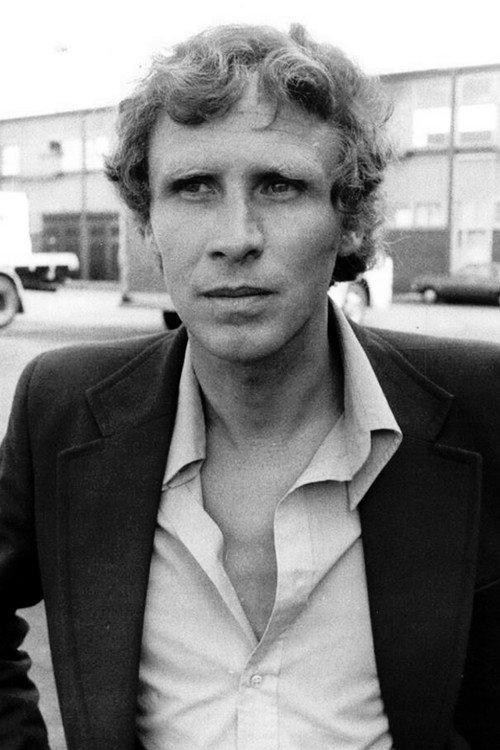
Dougal Haston
Biography
Duncan "Dougal" Curdy MacSporran Haston (19 April 1940 – 17 January 1977) was a Scottish mountaineer noted for his exploits in the British Isles, Alps, and the Himalayas. From 1967 he was the director of the International School of Mountaineering at Leysin, Switzerland, a role he held until his death in an avalanche while skiing above Leysin.
Known For & Full Filmography9 Titles

Movie - 1967, 2h 15m • as Self
In July of 1967, 15 million people watched one of the most audacious BBC outside broadcasts ever undertaken - the climbing of the Old Man of Hoy. Chris Bonnington and Tom Patey, took the East Face; Joe Brown and Ian McNaught-Davis, the South Face; Peter Crew and Douglas Haston took the South-East Arête. A further crew of four climbers- Hamish MacInnes, John Cleare, Rusty Baillie and Ian Clough carried cameras and transmitters. The live broadcast consisted of 6 connections between 7th and 9th of july whose titles were: The Old Man and The Climbers, Six Men, The Bivouac, Six Men-One Challenge, The first man to the summit, The Challenge and the Conquest. One week later BBC broadcasted a 30-minute program with the highlights of the live coverage.

Movie - 2006, 2h 15m • as Self
Don Whillans was one of the leading rock climbers of his generation. This film examines Don’s gritstone horrors, his hard routes in Wales, then follows him to the Alps and beyond on several of his epic expeditions. But it also focuses on Don’s unique humor, his devastating oneliners that pricked pomposity wherever he found it and poked fun at those who deserved it. Don may have died 20 years ago but the myth surrounding Whillans can still be heard whenever climbers reminisce about a time when hard men were hard and legends were being made. Perhaps his partner Joe Brown best sums him up, 'Don was unique'.

Movie - 1992, 2h 15m • as Self (archive footage)
Commemorative program for the 25th anniversary of the live broadcast of the ascent of the Old Man of Hoy. In July of 1967, 15 million people watched one of the most audacious BBC outside broadcasts ever undertaken - the climbing of the 'Old Man of Hoy'. Chris Bonnington and Tom Patey, took the East Face; Joe Brown and Ian McNaught-Davis, the South Face; Peter Crew and Douglas Haston took the South-East Arête. A further crew of four climbers- Hamish MacInnes, John Cleare, Rusty Baillie and Ian Clough carried cameras and transmitters. 25 years later, BBC gathers the protagonists to recover the footage and to look back on the achievement.

Movie - 1967, 2h 15m • as Self
A making of the live broadcast of the ascent of the Old Man of Hoy. In July of 1967, 15 million people watched one of the most audacious BBC outside broadcasts ever undertaken - the climbing of the 'Old Man of Hoy'. This is an account of how the BBC-1 television programme was organised, together with recordings made during the broadcast, and interviews with those who helped to make it possible as well as those who did the actual climb.

Movie - 1966, 2h 15m • as Self
From Trento to Chamonix, via Zermatt; from the Morgiou cove to the Eiger's north face; from Planica to the Lavaredo peaks, the Alps are depicted, illustrated, and magnified in all their unique and sublime beauty, through the sports practiced there and the most typical customs and traditions of their inhabitants. A helicopter rescue and a parachute jump from the Red Wall by Wolfgang Weizenbocks are experiences not to be missed.

Movie - 2005, 2h 15m • as Self
The film analyzes the brilliant if tragically short career and tempestuous personal life of Scottish mountaineer Dougal Haston (1940-77). Haston gained fame with the first ascent of 'The Bat' in 1959. He went on to make his name as a mountaineer in the Alps and greater ranges. In 1966 he was part of the team that made the first winter ascent of the Eiger Nordwand. He also achieved the first ascent of the South West face of Mount Everest in September 1975. Haston was the Director of the International School of Mountaineering in Leysin, Switzerland. He was killed in an avalanche in Leysin, Switzerland in 1977. Interviews and original footage give an insight into an iconic legend.

Movie - 1971, 2h 15m • as Self
In 1971, American Norman Dyhrenfurth led an expedition of 30 climbers from 13 different countries, including Don Whillans, Dougal Haston, Naomi Uemura, Pierre Mazeaud, Michel Vaucher, and others. This expedition aimed to simultaneously climb the southwest face and the direct west ridge. During the ascent, Indian climber Harsh Vardhan Bahuguna perished at Camp 3 in a storm. The expedition, already suffering from organizational problems, was severely tested after his death. The Americans decided, unilaterally, to abandon the west ridge. The Europeans, who had spent days equipping the route, were left out and felt relegated to the roles of route setters and porters. Frenchman Pierre Mazeaud, Swiss climbers Michel and Yvette Vaucher, and Italian Carlo Mauri then left the expedition. The Americans continued their ascent of the southwest face up to 8,350 meters before giving up.

Movie - 1971, 2h 15m • as Himself
This entertaining film documents the first ascent of the very difficult South Face of Annapurna, a huge Himalayan wall that the right team could achieve the seemingly impossible. The ascent of the South Face of Annapurna in 1970 was one of those breakthrough ascents - both technically and psychologically. Chris Bonington assembled the cream of British mountaineering and American Tom Frost for the attempt. The documentary is punctuated by wry observation, understatement and cutting humor from a by-gone age when the game of taking huge risks was matched by a determination not to take it too seriously.

Movie - 2014, 2h 15m • as Self (archive footage)
For twenty years, the Beghin-Lafaille route on the South Face of Annapurna was considered one of the most difficult and dangerous in the Himalayas. In the autumn of 2013, it was climbed first by Ueli Steck solo, and then by the team of Yannick Graziani and Stéphane Benoist. It is an extraordinary route that profoundly changed the lives of those who tackled it. The film recounts the remarkable convergence of destinies surrounding this climb and explores how such an ascent can transform a life. Drawing inspiration from the experiences of astronauts returning from the moon—who suffered from "absolute achievement" syndrome—the filmmakers sought to understand how the deep-seated drives that compel mountaineers to prepare for and commit to such climbs can shatter at the very moment a lifelong goal appears to have been reached.